
New Progress in Atomic-Level Precise Construction of Supported Noble Metal Catalysts from ECUST Published in Nature Communications
Recently, a research team led by Professor Wangcheng Zhan from the School of Chemistry and Molecular Engineering at ECUST achieved a breakthrough in the atomic-level precise design and construction of supported noble metal catalysts. The study, titled “Defect-engineered nonstoichiometric perovskite hosting high-activity PdO sites for enhanced hydrocarbon oxidation,” was published in Nature Communications.
Supported noble metal catalysts play an irreplaceable role in environmental protection and energy conversion. However, achieving precise control over the structure of metal nanoparticles at the atomic level and establishing clear structure-activity relationships remain core challenges in catalysis science. Conventional strategies typically enhanced metal-support interaction (MSI) by introducing defects into the support, thereby regulating metal dispersion and electronic structure. However, this approach made it difficult to precisely control the atomic-level microstructure of metal sites.
In this study, the researchers tuned the A-site defect density of the LaAlO₃ perovskite support to construct supports with distinct surface structures, including planar, stepped, and crater-like configurations. Through a structure-inducing mechanism, the geometric structure of supported PdO nanoparticles was precisely regulated at the atomic level. Combined experimental and theoretical results showed that PdO configurations enriched with step sites exhibit optimal activity in methane oxidation. This is because low-coordinated Pd atoms can stabilize Pd-C(CH₃) covalent bonds and promote C-H bond activation.
This study hasdemonstrates for the first time that atomic-level engineering of surface defects in perovskite supports enables precise control over the micro-geometric structure of supported noble metal nanoparticles. The strategy is broadly applicable and can be extended to alkane oxidation and other oxidation reaction systems, providing a promising route for developing highly efficient catalysts with low noble metal usage.
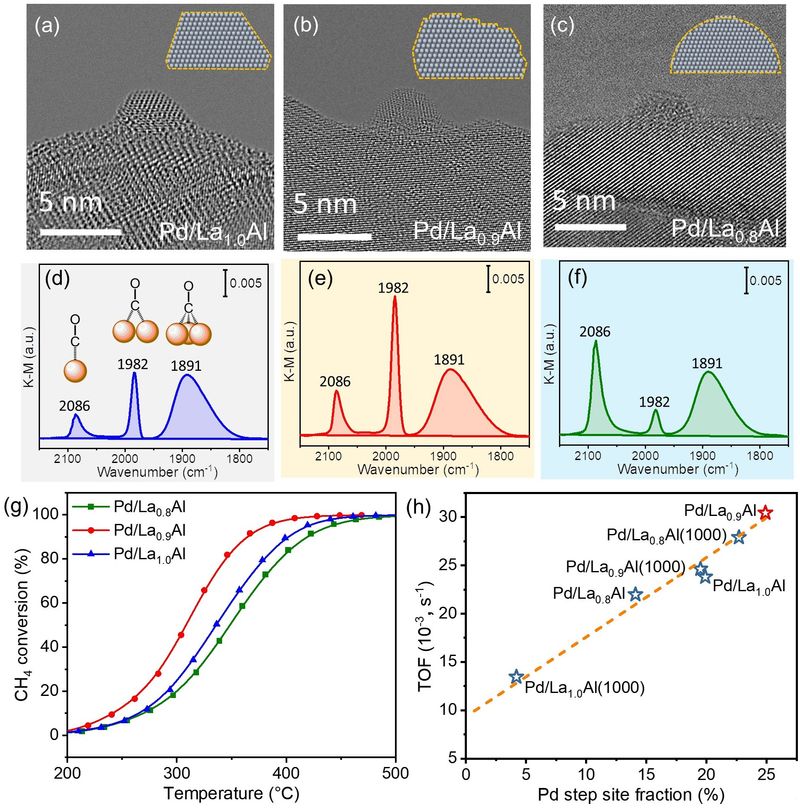
Figure caption: Atomic-level microstructures of PdO nanoparticles on LaAlO₃ perovskite supports with different A-site defect densities and their catalytic activity in methane combustion.
ECUST is the sole corresponding institution of the paper. Dr. Jihang Yu and Associate Professor Zhiqiang Wang are co-first authors, while Professor Wangcheng Zhan is the sole corresponding author. The research is supported by the State Key Laboratory of Green Chemical Engineering and Industrial Catalysis and the Feringa Nobel Prize Scientist Joint Research Center, with additional funding from the National Key R&D Program of China and the National Natural Science Foundation of China.