 13 Apr 2026
Recently, two research teams led by Gaowei Zheng from the School of Biological Engineering and Guisheng Fan from the School of Information Science and Engineering at ECUST collaborated to develop a novel deep learning-based enzyme mining strategy based on local motifs. Using this tool, they identified unreported native nicotinamide adenine dinucleotide (NADH)-dependent imine reductases (IREDs). The research findings were published online in Chem, a journal of Cell Press, titled “A motif-based deep learning tool for the identification of unusual NADH-dependent imine reductases”.
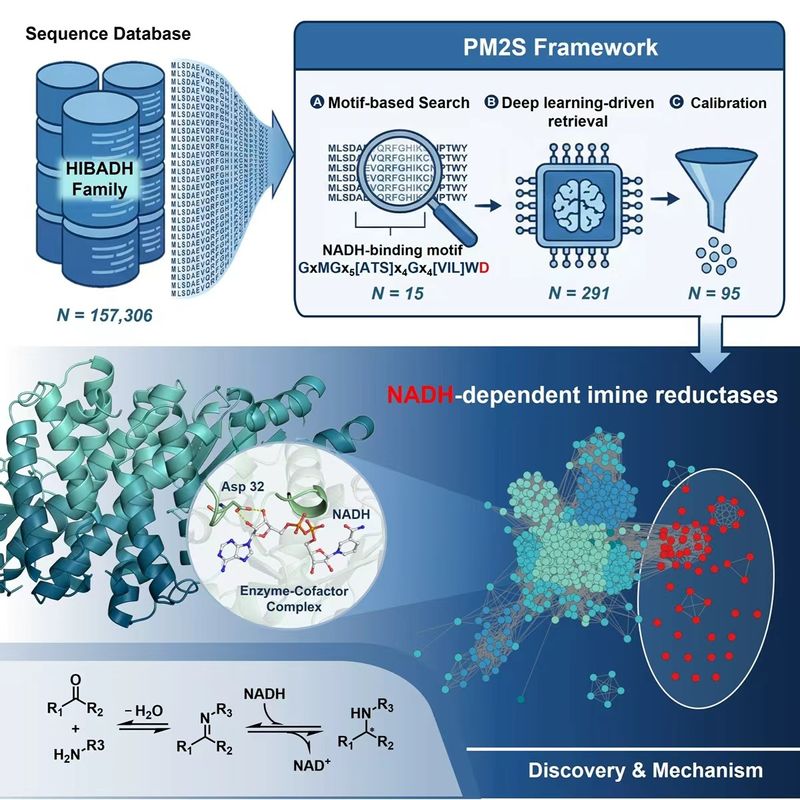
IREDs are important biocatalysts for synthesizing chiral amines, which are widely used in production of pharmaceutical intermediates. However, almost all IREDs are NADPH-dependent, and native NADH-dependent enzymes have not yet been reported. Due to the lack of a specific target sequence for NADH-dependent IREDs, traditional enzyme mining approaches based on sequence alignment algorithms are difficult to apply, which has hindered the discovery.
To address this limitation, the team developed the PM2S (Protein Motif to Search) strategy, integrating motif search, deep learning-driven iterative retrieval and result calibration. They successfully screened 95 candidate native NADH-dependent IREDs from 150,000 gene sequences. These enzymes prefer NADH as a cofactor, catalyze imine reduction and reductive amination with a broad substrate spectrum, and have also been applied in the synthesis of key intermediates for drugs such as cinacalcet.
In summary, this study established a novel enzyme mining tool combining “local conserved motifs + deep learning”, discovered a new class of native NADH-dependent IREDs, and elucidated the regulatory mechanism underlying their cofactor preference, laying a foundation for the modification of cofactor types in enzyme engineering and the construction of efficient biocatalytic systems.
Xinyuan Shen, a PhD candidate from the School of Biological Engineering, and Yuxuan Wu, a PhD candidate from the School of Information Science and Engineering, are the co-first authors of the paper. Professor Gaowei Zheng and associate professor Guisheng Fan are the co-corresponding authors. The research was supported by the National Key R&D Program of China and the National Natural Science Foundation of China.