
New Progress in Lithium Recovery from Strongly Acidic Systems from ECUST Published in Angewandte Chemie International Edition
Recently, a research team led by Jianguo Yu and Sen Lin, professors at the National Engineering Research Center for Integrated Utilization of Salt Lake Resources at ECUST, made progress in high-efficiency lithium recovery from strongly acidic systems. The study, entitled “An induced Li⁺ oriented migration strategy for high-efficiency extremely strong acid lithium recovery”, was published in Angewandte Chemie International Edition.
To address the limited applicability of conventional lithium extraction methods in strongly acidic solutions, the team developed an “induced Li⁺ oriented migration” strategy. Based on the structural characteristics of lithium-aluminum layered double hydroxides (Li/Al-LDHs), this approach utilizes Li⁺ migration between a directionally formed solid phase and aqueous solutions, achieving selective enrichment of Li⁺ ions from strongly acidic solutions containing massive coexisting cations, followed by efficient delithiation in neutral aqueous solutions. The strategy also allows the recycling of aluminum sources and waste-free disposal throughout the process.
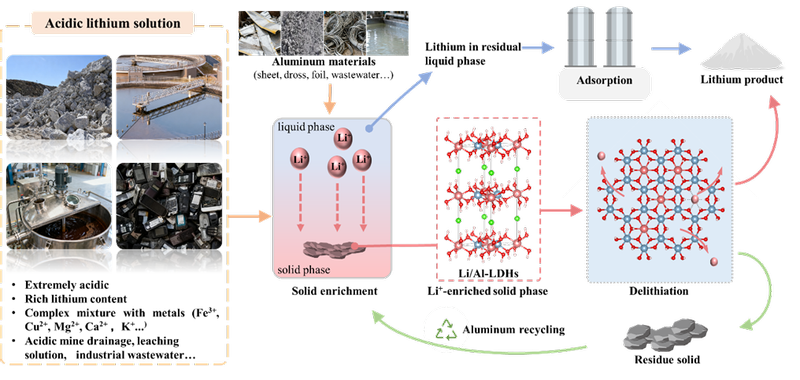
By establishing a non-equilibrium thermodynamic model, the research team revealed the chemical potential gradient driving mechanism of lithium ions among the laminate, interlayer, and bulk phases, and systematically elucidated the influence mechanisms of various key parameters on lithium recovery efficiency. The strategy demonstrates excellent lithium recovery performance and cost advantages in authentic multi-component strongly acidic systems, including spent lithium battery leachates, industrial wastewater, and acid mine drainage, achieving an overall lithium recovery rate exceeding 96%.
Yihong Guo, a PhD candidate at ECUST, and Haolan Tao, specially appointed associate research fellow at ECUST, are the co-first authors of the paper. Sen Lin and Cheng Lian, professors at ECUST, are the corresponding authors. The research was supported by the National Natural Science Foundation of China.