
New Progress in Near-Infrared Fluorogen-Activating Protein Imaging from ECUST Published in Nature Methods
Recently, a research team led by Yi Yang and Xianjun Chen, professors at the School of Pharmacy, State Key Laboratory of Bioreactor Engineering and the Optogenetics & Synthetic Biology Interdisciplinary Research Center of ECUST, made a breakthrough in near-infrared fluorogen-activating protein imaging together with Linyong Zhu, professor at Shanghai Jiao Tong University. Their study, entitled “NirFAP680: A Highly Bright and Stable Large Stokes Shift Near-Infrared Fluorogen-Activating Protein”, was published online in Nature Methods.
Traditional fluorescent proteins have advanced life sciences significantly, yet near-infrared variants remain limited by low brightness due to constraints in natural amino acids and endogenous chromophores. Against this backdrop, fluorescent genetic tools that combine the genetically encodable feature of fluorescent proteins with the high-brightness advantage of small-molecule fluorophores have emerged as a new research hotspot. To overcome these challenges, the team developed a novel fluorogen-activating system combining genetic encodability with high fluorophore brightness.
Based on a GFP-derived chromophore, the researchers designed a new near-infrared fluorogen, HBMT, featuring low background signal, high photostability, and good biocompatibility. Through directed evolution, they further engineered a compact protein tag, NirFAP (116 amino acids), which efficiently activated the fluorescence of HBMT. The resulting complex, NirFAP680, achieves a quantum yield of 0.56 and exhibits a cellular brightness 1 to 3 orders of magnitude higher than conventional near-infrared fluorescent proteins in live cells. It also showed superior performance under both single-photon and two-photon excitation.
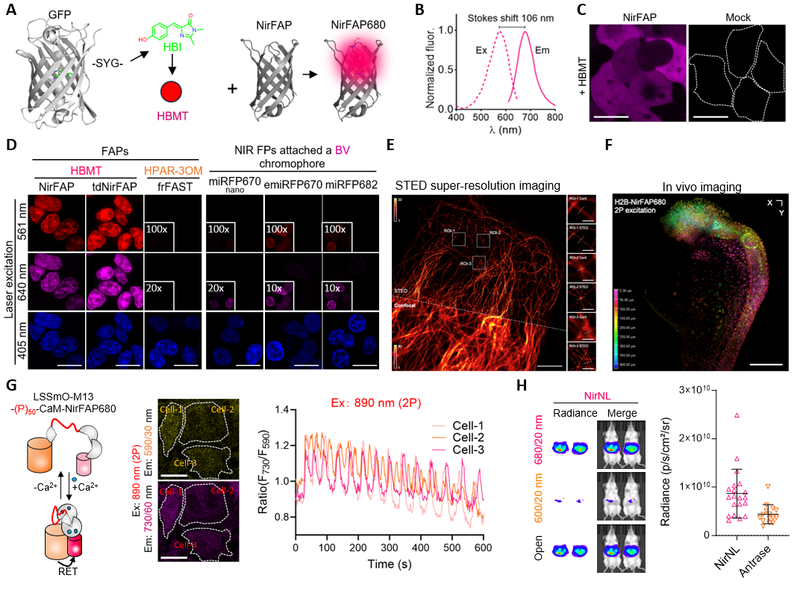
Leveraging these properties, NirFAP680 was successfully applied in live-cell super-resolution imaging, in vivo imaging of zebrafish neural networks and development, and neuronal imaging in mice. The team also developed a high-dynamic-range FRET system and an ultra-bright near-infrared bioluminescent protein, enabling sensitive detection of protein interactions and intracellular signaling.
Zhengda Chen, PhD candidate at Shanghai Jiao Tong University, and Li Jiang, specially appointed associate research fellow at ECUST, are the co-first authors of the paper. Linyong Zhu, professor at Shanghai Jiao Tong University, and Yi Yang and Xianjun Chen, professors at ECUST, are the corresponding authors. The research was supported by the National Key R&D Program of China, the National Natural Science Foundation of China, the Fundamental and Interdisciplinary Disciplines Research Breakthrough Program of the Ministry of Education, and the Shanghai Frontiers Science Center of Optogenetic Techniques for Cell Metabolism.