 28 Apr 2026
Recently, Professor You Yang’s team from the School of Pharmacy at ECUST, in collaboration with the teams of Academician Biao Yu (Shanghai Institute of Organic Chemistry, Chinese Academy of Sciences), Professor Liuqing Wen (Shanghai Institute of Materia Medica, Chinese Academy of Sciences), and Associate Professor Dapeng Zhu (Shanghai Jiao Tong University), published a review paper titled “Synthesis of Glycans: State of The Art and Future Perspectives” in CCS Chemistry. This work summarizes recent research progress in glycosylation methodologies, streamlined glycan assembly strategies, and the synthesis of complex glycans.
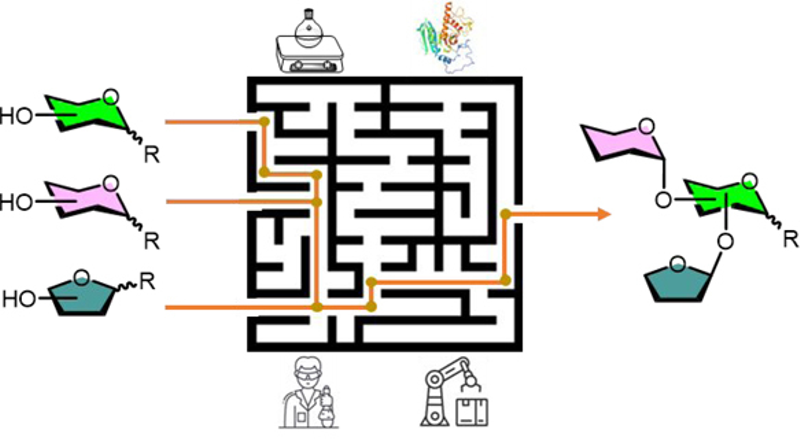
Glycans, the third major class of biological macromolecules after nucleic acids and proteins, play critical roles in core life processes such as cell recognition, immune response, and pathogen recognition. Due to the structural complexity and microheterogeneity of natural glycans, it is extremely challenging to obtain homogeneous glycans from natural sources.
Therefore, chemical and enzymatic synthesis have become the primary methods to access structurally defined glycans, which are indispensable for deciphering their biological functions and developing carbohydrate-based therapeutics and vaccines.
Building on the previous work by the teams, this paper analyzes recent advances in glycan synthesis and future perspectives. First, it outlines the biological functions of glycans, microheterogeneity in natural glycans, and the corresponding solutions to these challenges.
Then, glycan synthesis is categorized into chemical synthesis and (chemo-)enzymatic synthesis. The strategies for glycosidic bond formation and streamlined glycan assembly in each category are summarized, and the applications of different synthetic strategies in the synthesis of representative complex glycans are discussed.
Finally, the review outlines remaining challenges and future directions in glycan synthesis, including the integration of chemical and enzymatic synthesis, incorporating artificial intelligence and automation, and developing function-oriented glycan synthesis technologies. These approaches aim to further explore the biological functions of glycans, elucidate their mechanisms of action, and ultimately facilitate the development of new carbohydrate-based drugs, vaccines, and diagnostic tools.
PhD candidate Jiahao Fan (School of Pharmacy, ECUST), Dr. Shengzhou Ma (Shanghai Institute of Materia Medica, Chinese Academy of Sciences), and Dr. Weizhun Yang (Hangzhou Institute for Advanced Study, UCAS) are co-first authors of this paper.
The corresponding authors are Academician Biao Yu (Shanghai Institute of Organic Chemistry, Chinese Academy of Sciences), Associate Professor Dapeng Zhu (Shanghai Jiao Tong University), Professor You Yang (ECUST), and Professor Liuqing Wen (Shanghai Institute of Materia Medica, Chinese Academy of Sciences).
This work was supported by grants including the National Natural Science Foundation of China and the Strategic Priority Research Program of the Chinese Academy of Sciences.