
New Progress in Rice-Fish Coculture Research from ECUST Featured on the Cover of Current Biology
Recently, a research team led by Professor Nianfeng Wan from the School of Pharmacy at ECUST, in collaboration with researchers from China, the United Kingdom, France, the United States, Germany, Switzerland, Denmark, and Spain, published a cover article in Current Biology, titled “Trophic cascades drive sustainability in the agricultural heritage rice-fish coculture system”. The study provides scientific evidence supporting the rice-fish coculture system, a Globally Important Agricultural Heritage System with a history spanning thousands of years.
The research integrates experimental data from 18 countries worldwide and includes long-term field experiments and behavioral studies conducted in eastern China. Their analysis shows that this traditional practice not only increases yields but also suppresses herbivorous pests, the incidence of disease, and weeds through biodiversity-mediated trophic cascades and biological pest control, thereby providing a viable pathway for agroecological transformation and food security.
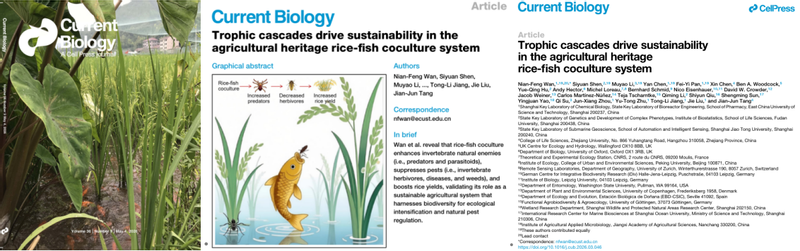
Global data shows that, compared with rice monoculture, rice-fish coculture increases rice yield by an average of 12.5% (depending on fish species), enhances the abundance of invertebrate natural enemies (predators/parasitoids) by 99.3%, and suppresses pest invertebrate herbivores (24.1%), disease (38.8%), and weeds (45.7%).
The effects on yield enhancement and pest suppression are more pronounced in temperate regions and field experiments than in tropical regions and pot experiments. Path analysis reveals that rice-fish coculture can directly suppress pests, disease, and weeds to increase yields at the second trophic level, and can also indirectly enhance yields by increasing natural enemy abundance that suppresses herbivores at the third trophic level. This enemy-driven top-down effect is widely observed across organic and non-organic systems, as well as temperate and tropical regions.
Four consecutive years of field experiments further confirm that in rice–fish coculture systems, major pests such as planthoppers and stem borers are significantly reduced, while predatory spiders increase in abundance, leading to improvements in thousand-grain weight and overall yield.
Behavioral assays show that crucian carp and red common carp preferentially feed on herbivores (e.g., brown planthoppers) while sparing predatory spiders, thereby reinforcing trophic cascades. Fish therefore act as “precision regulators,” directly reducing herbivore populations while conserving natural enemies and forming an efficient, synergistic pest-control network.
The study elucidates the ecological principles underlying this traditional practice: restoring biodiversity in paddy fields and driving trophic cascades can enable ecological intensification. It offers a scalable solution that integrates ecological and production benefits, providing viable solutions to global challenges such as food security, pesticide reduction, and biodiversity loss, and holds important implications for China’s ecological agriculture strategy.
ECUST is the first and corresponding institution of the study. Professor Nianfeng Wan serves as the corresponding author and co-first author. Co-first authors also include Siyuan Shen, Muyao Li, Yan Chen, and Feiyi Pan. Collaborating institutions include Zhejiang University, Fudan University, the University of Oxford, the French Academy of Sciences, and the University of Zurich. The research was supported by the National Natural Science Foundation of China and national high-level young talent programs.